Malcolm X: By Any Means Necessary – The Philosophy & Legacy of Revolutionary Resistance
Few phrases in American civil rights history carry the weight and revolutionary power of Malcolm X’s declaration: “By any means necessary.” These four words encapsulate a philosophy of Black liberation that challenged the status quo and continues to resonate in social justice movements today. Beyond the sound bite that has appeared on countless posters and t-shirts lies a complex ideology born from Malcolm X’s evolving understanding of racial justice, self-determination, and human rights. This article explores the origins, meaning, and enduring legacy of Malcolm X’s most famous call to action—a philosophy that transformed the landscape of civil rights activism and continues to inspire resistance movements worldwide.
The Origin and Context of “By Any Means Necessary”
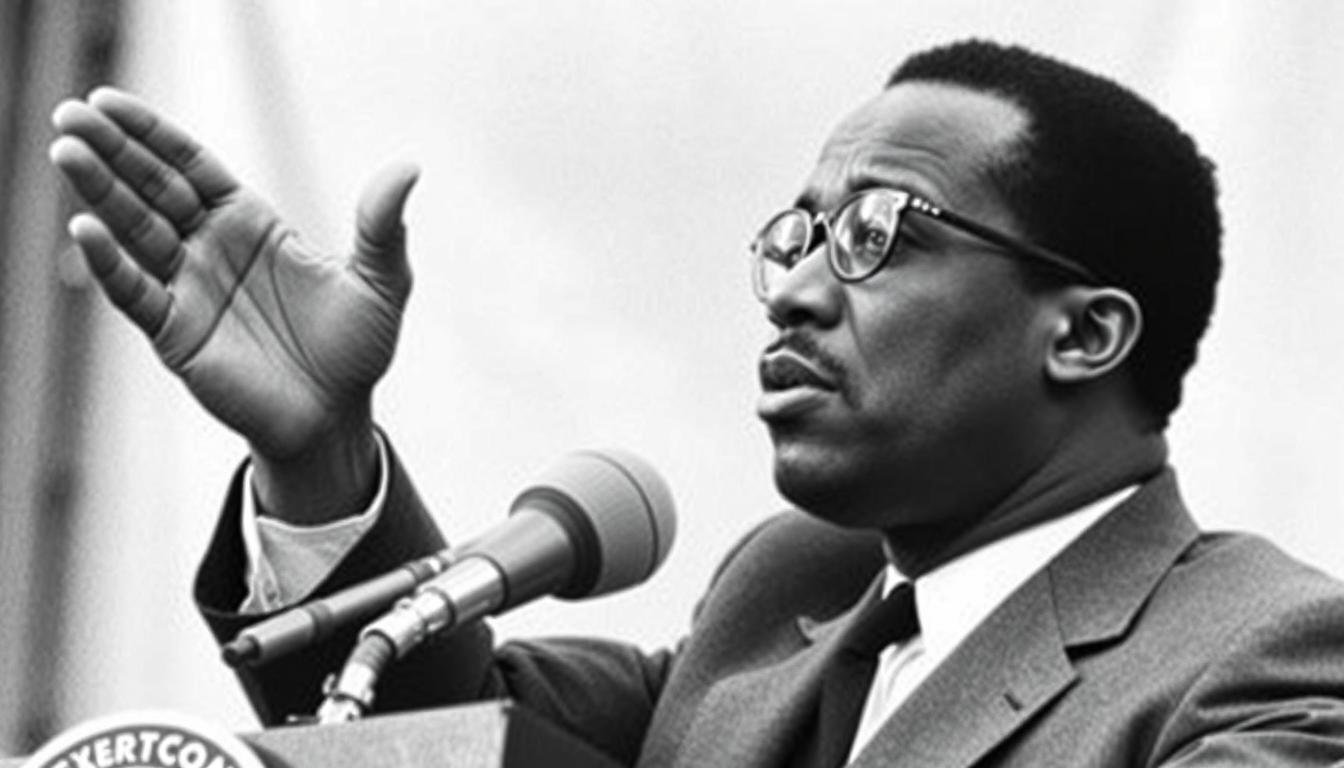
Malcolm X delivers his historic speech at the founding rally of the Organization of Afro-American Unity on June 28, 1964, where he first publicly used the phrase “by any means necessary.”
On June 28, 1964, at the founding rally of the Organization of Afro-American Unity (OAAU) in New York’s Audubon Ballroom, Malcolm X delivered a speech that would forever change the language of resistance. Having recently broken from the Nation of Islam and returned from his pilgrimage to Mecca, Malcolm was in a period of profound ideological transformation. It was during this pivotal address that he first publicly declared: “We want freedom by any means necessary. We want justice by any means necessary. We want equality by any means necessary.”
The phrase wasn’t merely rhetorical flourish—it represented Malcolm’s evolved understanding of Black liberation following his split from the Nation of Islam (NOI) just months earlier in March 1964. This separation came after growing tensions with NOI leader Elijah Muhammad and Malcolm’s increasing desire to engage more directly with the broader civil rights movement and international human rights struggles.
Break from the Nation of Islam
Malcolm’s departure from the NOI marked a critical turning point in his ideology. While he maintained his critique of white supremacy, his approach became more politically focused and internationally oriented. As he explained in the OAAU founding speech: “We declare our right on this earth to be a man, to be a human being, to be respected as a human being, to be given the rights of a human being in this society, on this earth, in this day, which we intend to bring into existence by any means necessary.”
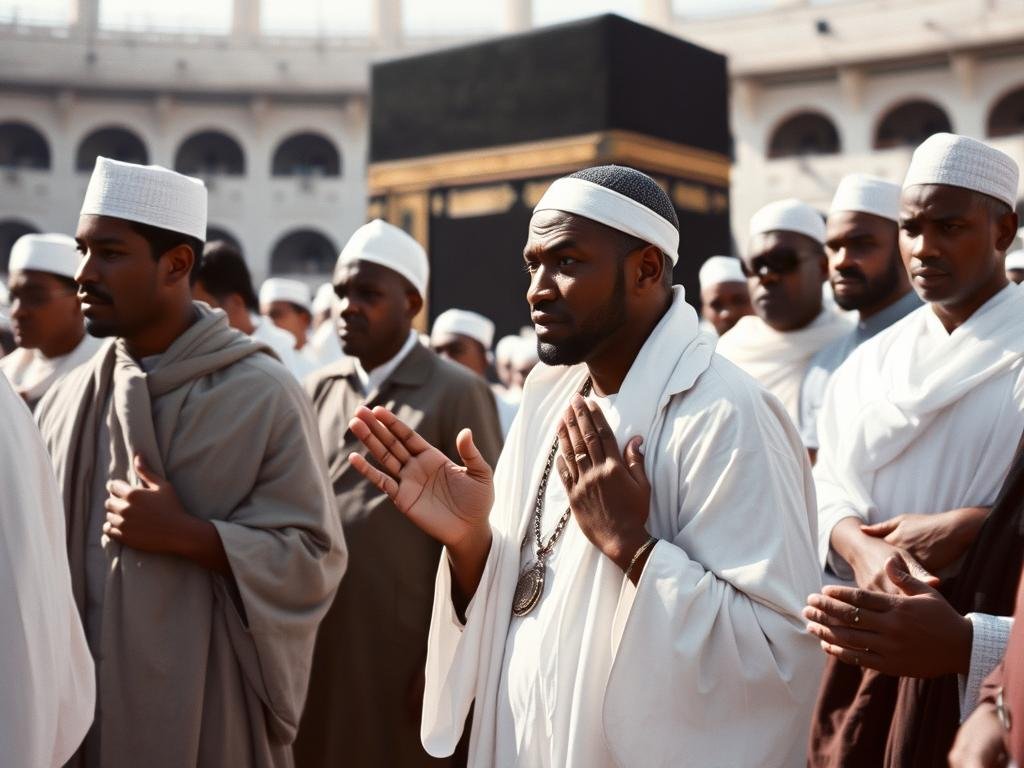
Malcolm X during his pilgrimage to Mecca in 1964, an experience that profoundly transformed his worldview and approach to racial justice.
The OAAU and Pan-African Vision
The Organization of Afro-American Unity, modeled after the Organization of African Unity, represented Malcolm’s vision for Black self-determination and international solidarity. The OAAU’s charter, presented during that same June 1964 speech, outlined a comprehensive program addressing education, politics, economics, social issues, and culture. Malcolm envisioned the OAAU as a vehicle for uniting Black Americans in their struggle while connecting them to the broader Pan-African movement.
The phrase “by any means necessary” was borrowed from French philosopher Jean-Paul Sartre, who used it in his 1948 play “Dirty Hands.” Malcolm’s adoption of the phrase reflected his intellectual engagement with revolutionary thought beyond American borders and his growing connection to global liberation movements.
Explore Malcolm X’s Complete Speeches
Discover the full context and power of Malcolm X’s revolutionary ideas by exploring his complete speeches and writings. Understand the evolution of his thinking from his early Nation of Islam days through his final year of international human rights advocacy.
Contrasting Approaches: Malcolm X and Martin Luther King Jr.
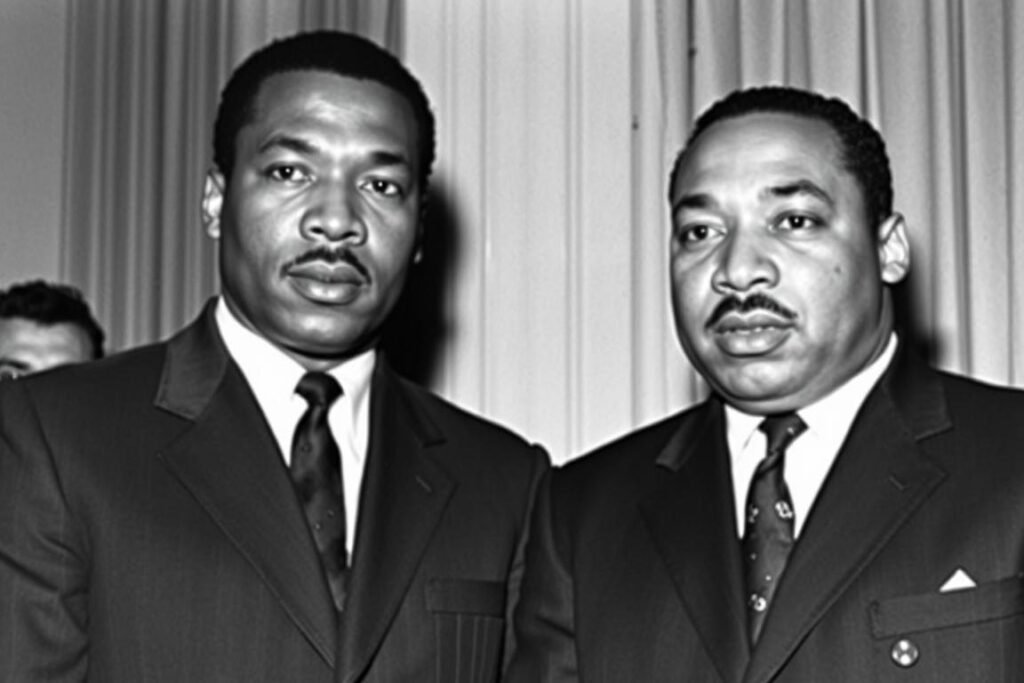
The only known photograph of Malcolm X and Martin Luther King Jr. together, taken during their brief meeting in Washington D.C. in March 1964.
The philosophical divide between Malcolm X and Martin Luther King Jr. represents one of the most significant ideological debates in American civil rights history. While both men sought justice and equality for Black Americans, their approaches and underlying philosophies differed dramatically.
Nonviolence vs. Self-Defense
King advocated for nonviolent resistance, drawing inspiration from Mahatma Gandhi and Christian theology. His approach emphasized moral persuasion, civil disobedience, and appealing to the conscience of white America. As King famously stated, “Nonviolence is a powerful and just weapon, which cuts without wounding and ennobles the man who wields it.”
Malcolm, conversely, emphasized the right to self-defense and rejected nonviolence as a universal strategy. “I don’t call it violence when it’s self-defense,” Malcolm argued. “I call it intelligence.” He criticized the nonviolent approach as enabling further violence against Black people: “We should be peaceful, law-abiding, but the time has come for the American Negro to fight back in self-defense whenever and wherever he is being unjustly and unlawfully attacked.”
“Don’t ever mistake my silence for acceptance, my calmness for satisfaction, my kindness for weakness. If you do this, you will only be making a grave mistake.”
Integration vs. Separation
King’s vision centered on integration and the creation of a “beloved community” where Black and white Americans could live together in harmony. He fought for desegregation and equal access to public accommodations, voting rights, and economic opportunities within the existing American system.
Malcolm, particularly during his Nation of Islam years, advocated for Black separation and self-determination. He questioned the value of integration into what he viewed as a fundamentally corrupt system: “I don’t see any American dream; I see an American nightmare.” Even after leaving the NOI, Malcolm maintained his emphasis on Black self-reliance and community control rather than integration as an end goal.
Public Debates and Mutual Evolution
The two leaders rarely engaged directly but often commented on each other’s approaches. King criticized Malcolm’s rhetoric as “fiery, demagogic oratory” that could only lead to greater violence. Malcolm, in turn, characterized King’s approach as begging for rights that should already belong to Black Americans.
However, in the final years of Malcolm’s life, the ideological gap between the two men began to narrow. Malcolm, following his break with the NOI and travels abroad, became more open to working with diverse allies, while King became increasingly radical in his critique of American capitalism, militarism, and systemic racism.
King’s Approach
- Nonviolent civil disobedience
- Christian love ethic (agape)
- Integration into American society
- Appeal to moral conscience
- Coalition-building with white allies
Malcolm’s Approach
- Self-defense “by any means necessary”
- Black nationalism and self-determination
- Community control and self-reliance
- International human rights framework
- Pan-African solidarity
Deepen Your Understanding of Civil Rights Philosophies
Explore the complex relationship between different approaches to civil rights activism through primary sources, scholarly analyses, and historical context.
Analyzing “By Any Means Necessary” as a Philosophy

Malcolm X with a rifle at his home after receiving death threats in 1964, embodying his philosophy of self-defense rather than passive acceptance of violence.
Malcolm X’s “by any means necessary” philosophy has often been misinterpreted as a blanket endorsement of violence. A closer examination reveals a more nuanced approach centered on three key principles: the right to self-defense, Pan-African solidarity, and anti-colonialism.
Self-Defense as a Human Right
Central to Malcolm’s philosophy was the assertion that self-defense is a fundamental human right. In the OAAU charter, he stated: “We assert that in those areas where the government is either unable or unwilling to protect the lives and property of our people, that our people are within our rights to protect themselves by whatever means necessary.”
This position emerged from Malcolm’s observation of continued violence against Black Americans despite civil rights legislation. He argued that nonviolence in the face of violent oppression was not moral but suicidal: “It is criminal to teach a man not to defend himself when he is the constant victim of brutal attacks.”
Importantly, Malcolm distinguished between offensive violence and defensive resistance. As he clarified: “I am for violence if non-violence means we continue postponing a solution to the American black man’s problem—just to avoid violence.”
Pan-Africanism and Global Solidarity
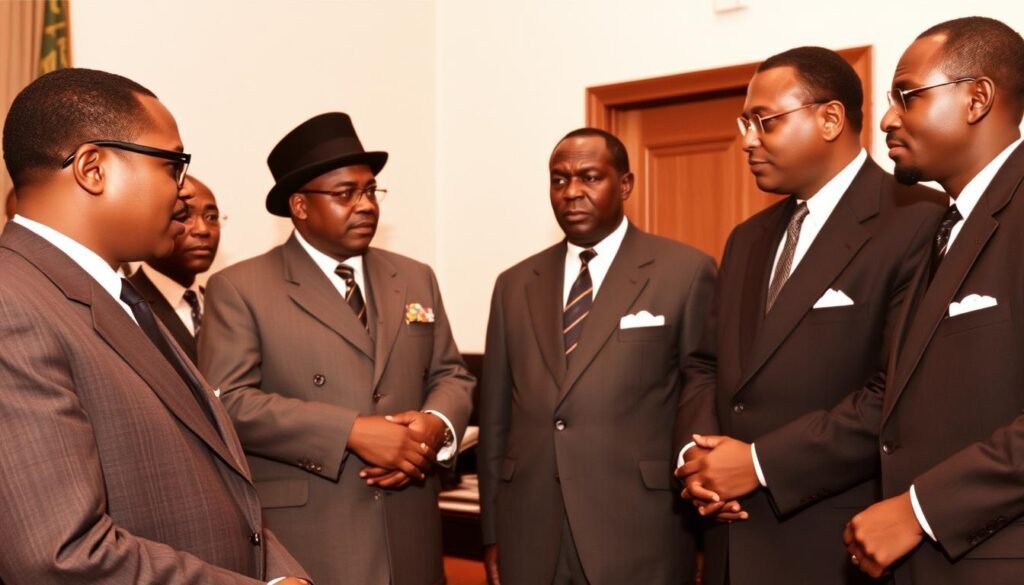
Malcolm X meeting with African leaders during his 1964 travels, building international solidarity for the Black liberation struggle.
Malcolm’s “by any means necessary” philosophy was deeply connected to his Pan-African vision. The OAAU was explicitly modeled after the Organization of African Unity, and Malcolm saw the struggle of Black Americans as inseparable from the anti-colonial movements across Africa.
In his speech “The Ballot or the Bullet,” Malcolm emphasized this connection: “In this present era of international struggle between the oppressed and the oppressor, we find that we are directly involved and affected here in America by what happens on the African continent and what happens in Asia and what happens in Latin America.”
This international perspective informed Malcolm’s strategy of bringing human rights charges against the United States before the United Nations—seeking to internationalize what America considered a domestic issue.
Anti-Colonialism and Human Rights
Malcolm increasingly framed the Black American struggle within an anti-colonial context, particularly after his travels to Africa and the Middle East. He drew parallels between the condition of Black Americans and colonized peoples worldwide, arguing that “by any means necessary” reflected the same principle of self-determination that guided anti-colonial movements.
In his final year, Malcolm emphasized human rights over civil rights, stating: “We need to expand the civil-rights struggle to a higher level—to the level of human rights… Civil rights means you’re asking Uncle Sam to treat you right. Human rights are something you were born with.”
“We declare our right on this earth to be a man, to be a human being, to be respected as a human being, to be given the rights of a human being in this society, on this earth, in this day, which we intend to bring into existence by any means necessary.”
Read Malcolm X’s Autobiography
Understand the full evolution of Malcolm X’s philosophy through his own words in “The Autobiography of Malcolm X,” as told to Alex Haley—a powerful account of his journey from Malcolm Little to El-Hajj Malik El-Shabazz.
Modern Interpretations in Social Justice Movements
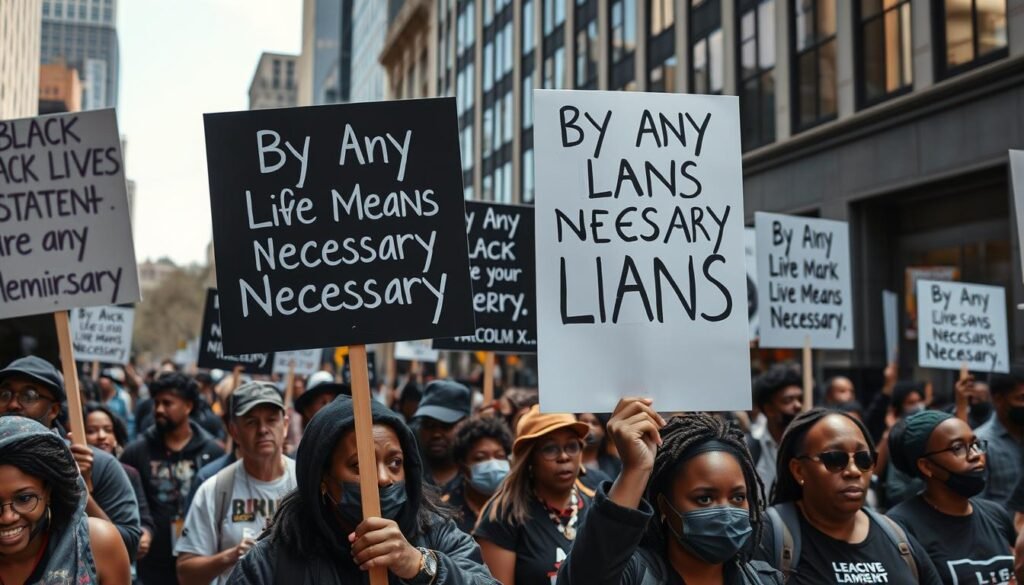
Black Lives Matter protesters carrying signs with Malcolm X quotes, demonstrating his enduring influence on contemporary social justice movements.
Malcolm X’s “by any means necessary” philosophy continues to resonate in contemporary social justice movements, particularly in Black Lives Matter (BLM) and broader anti-racism efforts. Modern activists have reinterpreted and applied his ideas to address ongoing systemic racism and state violence.
Black Lives Matter and Self-Defense
The Black Lives Matter movement, formed in response to police violence against Black Americans, echoes Malcolm’s emphasis on self-determination and resistance to state oppression. While BLM organizers generally advocate nonviolent protest, they have embraced Malcolm’s critique of respectability politics and his insistence on demanding—rather than requesting—fundamental rights.
Patrisse Cullors, a BLM co-founder, has cited Malcolm X as a key influence: “Malcolm X’s analysis of the way in which racism functions, the way in which white supremacy functions, has been deeply influential to this generation.” The movement’s emphasis on direct action rather than merely working through established political channels reflects Malcolm’s skepticism of gradual reform.
Anti-Racism and Systemic Change
Contemporary anti-racism movements have drawn on Malcolm’s analysis of systemic racism and his call for fundamental transformation rather than incremental reform. His critique of white liberalism and insistence on addressing the root causes of racial inequality remain relevant in discussions of anti-racism work today.
Ibram X. Kendi, author of “How to Be an Antiracist,” has noted parallels between Malcolm’s approach and modern anti-racism: “Malcolm X was one of the first to articulate that the opposite of racist isn’t ‘not racist,’ it’s antiracist. He understood that in the struggle against racism, there is no neutrality.”
Digital Activism and Global Solidarity
Social media has enabled new forms of activism that reflect Malcolm’s emphasis on building international solidarity. Hashtag campaigns like #BlackLivesMatter have connected struggles across national boundaries, similar to Malcolm’s efforts to link the Black American freedom struggle with anti-colonial movements worldwide.
The rapid dissemination of videos documenting police violence has created what some scholars call “the new witnessing public”—a digital manifestation of Malcolm’s strategy of exposing American racism to international scrutiny.
Self-Determination
Modern movements emphasize community control, police accountability, and autonomous zones as expressions of self-determination similar to Malcolm’s vision.
Direct Action
Contemporary activists employ direct action tactics beyond traditional political channels, reflecting Malcolm’s critique of relying solely on electoral politics.
International Solidarity
Today’s movements build global connections between struggles against oppression, from Palestine to Ferguson, echoing Malcolm’s Pan-African vision.
Connect with Contemporary Social Justice Resources
Explore how Malcolm X’s philosophy continues to influence modern movements for racial justice and learn how you can engage with these ongoing struggles.
Controversies and Criticisms of the “Any Means” Concept
Despite its powerful resonance, Malcolm X’s “by any means necessary” philosophy has faced significant criticism from various quarters, both during his lifetime and in subsequent decades. Understanding these critiques provides a more complete picture of the ongoing debates surrounding his legacy.
Accusations of Promoting Violence
The most persistent criticism of Malcolm’s philosophy has been that it promotes or glorifies violence. Critics, including some civil rights leaders of his era, argued that “by any means necessary” provided justification for riots and violent confrontation that could ultimately harm the Black community.
Roy Wilkins of the NAACP once stated that Malcolm’s rhetoric was “a call for black supremacy” that would lead to “a racial holocaust.” These criticisms often failed to distinguish between Malcolm’s advocacy for self-defense and any call for offensive violence, which he repeatedly denied.
Newspaper headlines from the 1960s demonstrating the mainstream media’s often hostile portrayal of Malcolm X’s philosophy.
Tactical Effectiveness Debates
Some critics, even those sympathetic to Malcolm’s goals, questioned the tactical effectiveness of his approach. They argued that the “by any means necessary” stance could alienate potential allies, provide justification for state repression, and ultimately prove counterproductive to achieving Black liberation.
Bayard Rustin, a key strategist of the civil rights movement, criticized Malcolm’s approach as lacking a concrete program: “Malcolm had the charisma to tell it like it is, but he didn’t have the political sense to tell it like it could be.”
Evolving Interpretations
Malcolm’s own interpretation of “by any means necessary” was evolving in the final year of his life. After his break with the Nation of Islam and his travels abroad, he began to emphasize coalition-building and political solutions alongside self-defense. This evolution has led to debates about how Malcolm himself would have applied this philosophy had he lived longer.
Historian Manning Marable argued in his biography “Malcolm X: A Life of Reinvention” that Malcolm was moving toward a more inclusive revolutionary humanism that maintained the right to self-defense while seeking broader alliances.
Defenders Argue
- Self-defense is a fundamental human right
- The phrase emphasizes determination, not violence
- It acknowledges the reality of resistance to oppression
- It empowers communities to define their own liberation
- It recognizes that different contexts require different tactics
Critics Argue
- The phrase can be interpreted as endorsing violence
- It may alienate potential allies and supporters
- It could provide justification for state repression
- It lacks specific tactical guidance
- It may overlook the effectiveness of nonviolent resistance
Contemporary Criticisms
In modern contexts, some critics argue that invoking “by any means necessary” without sufficient historical context can lead to misappropriation or misunderstanding. Others suggest that the phrase has become commercialized and divorced from its revolutionary implications.
Some contemporary scholars have also noted that Malcolm’s philosophy, while revolutionary in many respects, did not fully address issues of gender and sexuality that are central to intersectional movements today.
Explore Scholarly Perspectives on Malcolm X
Dive deeper into academic analyses of Malcolm X’s philosophy and its complexities through scholarly articles, books, and resources that provide nuanced perspectives on his legacy.
The Enduring Legacy of “By Any Means Necessary”
More than half a century after his assassination, Malcolm X’s “by any means necessary” philosophy continues to shape cultural expressions, political movements, and activist strategies. Its enduring power lies in its adaptability to new contexts while maintaining its core emphasis on self-determination and unyielding resistance to oppression.
Cultural Impact: Spike Lee’s “Malcolm X” and Beyond
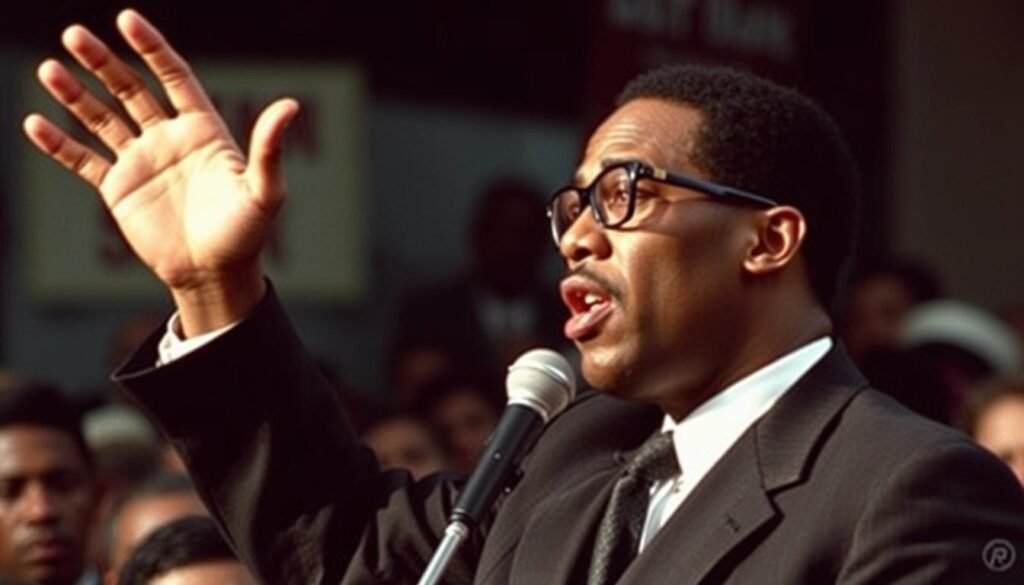
Denzel Washington as Malcolm X in Spike Lee’s 1992 biopic, which introduced Malcolm’s philosophy to a new generation.
Spike Lee’s 1992 biopic “Malcolm X,” starring Denzel Washington, brought Malcolm’s life story and philosophy to mainstream audiences worldwide. The film’s portrayal of Malcolm’s evolution from street hustler to revolutionary leader helped cement his place in popular culture and introduced his ideas to a new generation.
Beyond cinema, Malcolm’s image and words have appeared in countless songs, poems, visual art, and fashion. Artists from Public Enemy to Beyoncé have referenced Malcolm in their work, while his image has become an iconic symbol of Black resistance and dignity.
The phrase “by any means necessary” itself has transcended its original context to become a cultural touchstone, appearing on everything from academic texts to t-shirts, often accompanied by the image of Malcolm with his finger pointed upward or holding a rifle.
Political Slogans and Movement Building
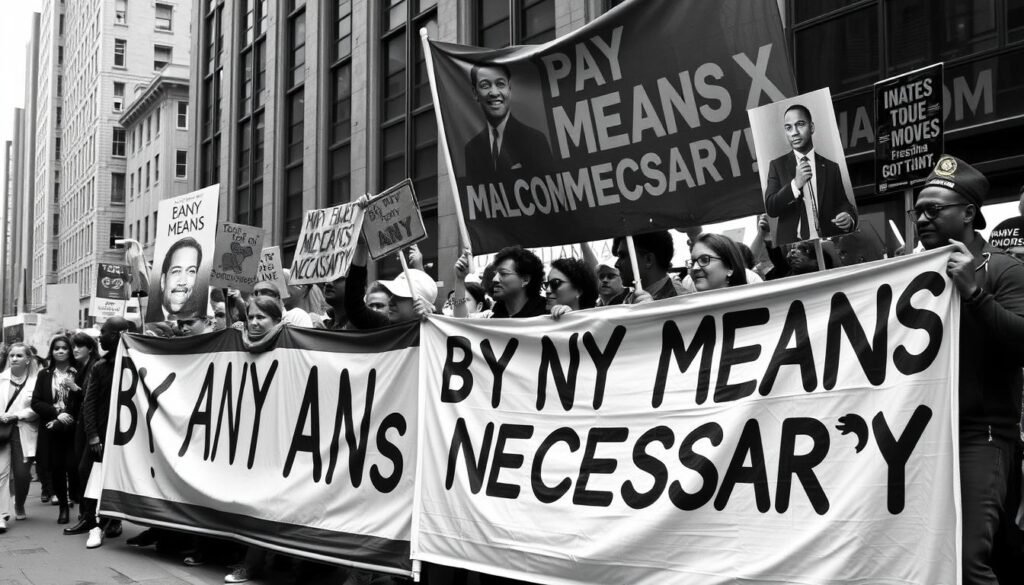
Contemporary activists carrying banners with Malcolm X’s words at a rally for racial justice, demonstrating the continued political relevance of his philosophy.
As a political slogan, “by any means necessary” has been adopted by various movements beyond Black liberation. Environmental activists, anti-war protesters, and indigenous rights advocates have all invoked the phrase to express their determination to achieve justice despite institutional resistance.
The Revolutionary People’s Constitutional Convention of 1970, organized by the Black Panther Party, explicitly built on Malcolm’s philosophy. More recently, the Malcolm X Grassroots Movement and similar organizations have continued to apply his ideas to contemporary struggles against police violence and mass incarceration.
In electoral politics, candidates ranging from local activists to members of Congress have drawn on Malcolm’s critique of the two-party system and his emphasis on community control of resources and institutions.
Activist Strategies and Tactical Diversity
Perhaps the most significant aspect of Malcolm’s legacy is his influence on activist strategies. His insistence on tactical flexibility—using whatever methods are effective in a given context—has informed movements that employ a diversity of tactics rather than adhering to strict nonviolence or any other single approach.
Contemporary movements often reflect Malcolm’s emphasis on self-defense and community protection. Organizations like Copwatch, which document police interactions with community members, and community patrol groups echo Malcolm’s call for communities to protect themselves when the state fails to do so.
Malcolm’s international perspective has also influenced modern activism. From the Movement for Black Lives’ solidarity with Palestinians to indigenous water protectors connecting their struggle to global environmental justice, his vision of international solidarity continues to shape how movements build power across borders.
Cultural Legacy
- Spike Lee’s “Malcolm X” film (1992)
- Hip-hop references (Public Enemy, Jay-Z, Nas)
- Visual art and photography exhibitions
- Fashion and iconography
- Literary works inspired by his philosophy
Political Legacy
- Black Panther Party’s Ten-Point Program
- Malcolm X Grassroots Movement
- Revolutionary Action Movement
- Black radical tradition in politics
- Community control movements
Activist Legacy
- Diversity of tactics approach
- Community self-defense organizations
- International solidarity frameworks
- Human rights over civil rights framing
- Direct action strategies
Experience Malcolm X’s Legacy Through Film
Watch Spike Lee’s landmark film “Malcolm X” to experience the power of Malcolm’s journey and philosophy through Denzel Washington’s Academy Award-nominated performance.
Conclusion: The Continuing Relevance of Malcolm X’s Philosophy
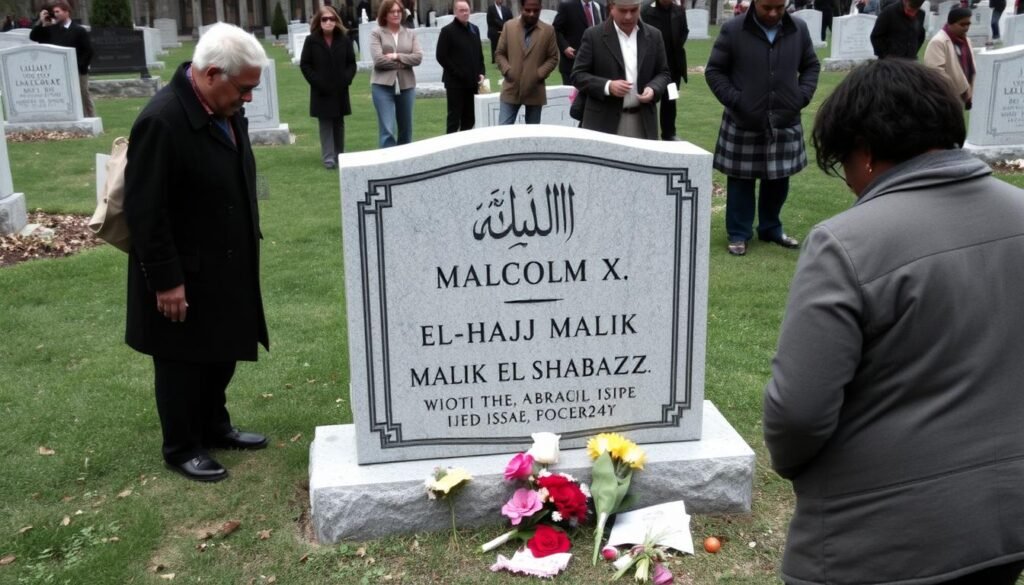
Visitors at Malcolm X’s grave at Ferncliff Cemetery in Hartsdale, New York, demonstrating his continued significance to new generations.
Malcolm X’s declaration that freedom, justice, and equality must be secured “by any means necessary” remains one of the most powerful and controversial philosophies in American history. Far from a simple call to arms, it represents a complex worldview that emphasizes self-determination, tactical flexibility, and unwavering commitment to human dignity.
As racial injustice continues to plague American society, Malcolm’s analysis of systemic racism and his insistence on the right to self-defense remain painfully relevant. His evolution from narrow nationalism to global human rights advocacy offers a model for how revolutionary thinking can develop and adapt without compromising its core principles.
Perhaps most importantly, Malcolm’s philosophy challenges us to question comfortable narratives about progress and to remain vigilant against the temptation to prioritize order over justice. In a world still marked by profound inequality, his words remind us that true freedom requires not just hope but determination—a willingness to secure human rights through whatever means prove necessary.
“If you’re not ready to die for it, put the word ‘freedom’ out of your vocabulary.”
As we continue to grapple with questions of justice, resistance, and liberation, Malcolm X’s legacy offers not simple answers but a framework for approaching these challenges with clarity, courage, and an unwavering commitment to human dignity. His life and words remind us that the struggle for freedom is never complete—and that each generation must determine for itself what means are necessary to advance the cause of justice.
Continue Learning About Malcolm X
Deepen your understanding of Malcolm X’s life, philosophy, and legacy through books, documentaries, and educational resources that provide comprehensive insights into his revolutionary ideas.